


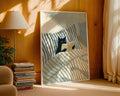
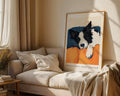
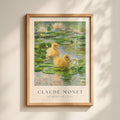
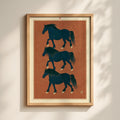
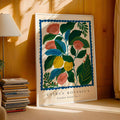
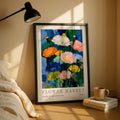




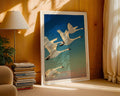



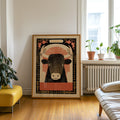
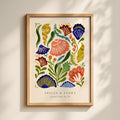
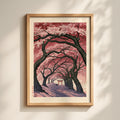
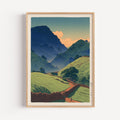
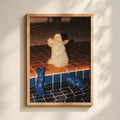
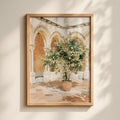
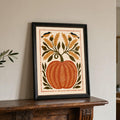


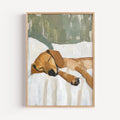

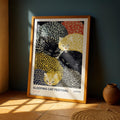






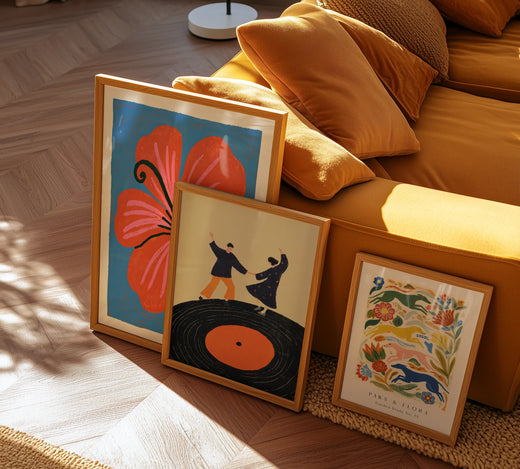
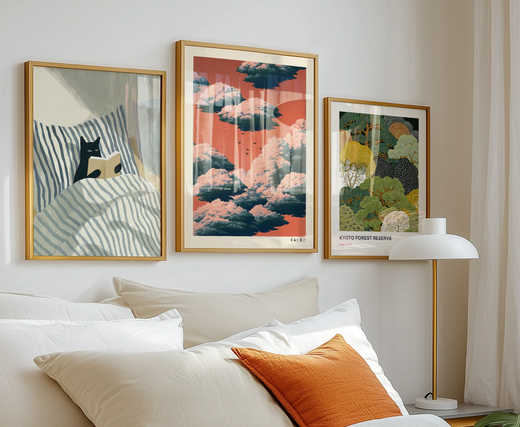

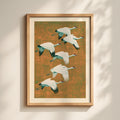

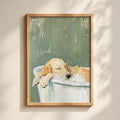

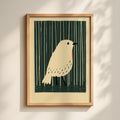
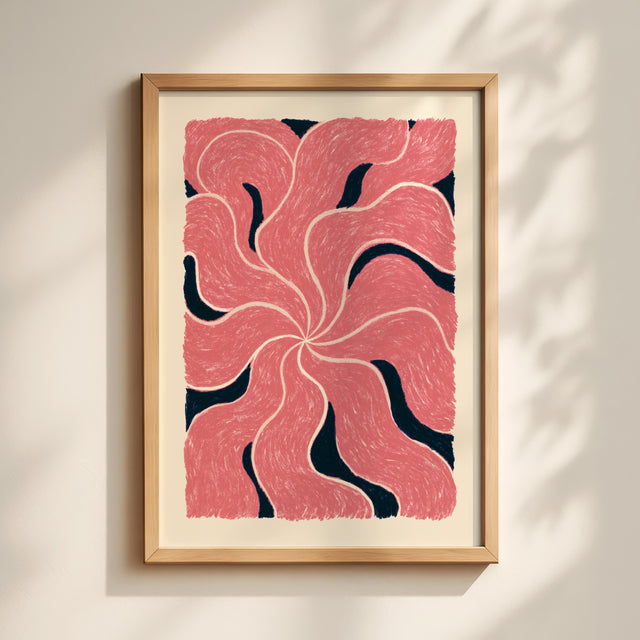



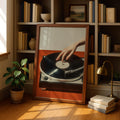

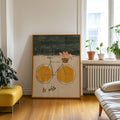


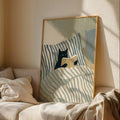
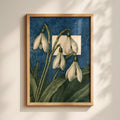


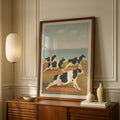








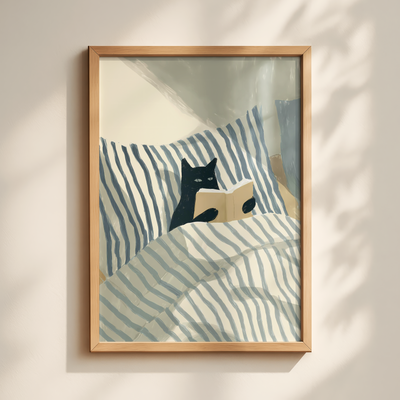
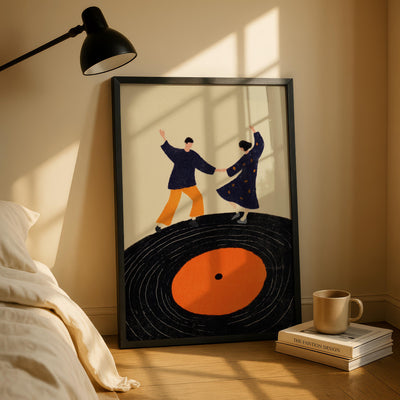
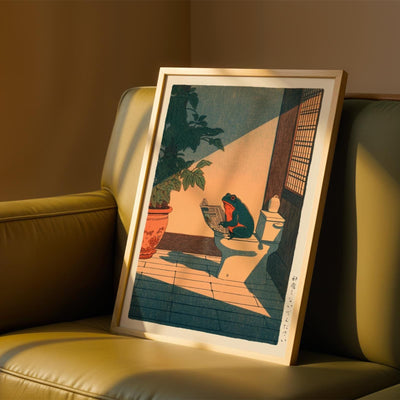


An autumn living room comes from shifting colour, light and texture a few degrees warmer. Rust, bark and ochre take the place of pale blues and greys, lamps take over from the ceiling light, a heavier throw lands on the sofa, and at least one print on the wall moves into a warmer palette.
Most of it is rearranging what you already own. The one thing worth measuring is the print that carries the room, and the sizes for a 200 cm sofa are in the second idea below.
In short
Above a 200 cm sofa, aim for about 133 cm of print, hung 15 to 25 cm above the sofa back.
Use bulbs around 2,700 K in the living room lamps.
Leave the ceiling light off in the evening, because it flattens the whole room from above.
Contents 10 sections
- Warm the palette with rust, ochre and bark
- Size and hang one print properly above the sofa
- Swap in heavier textiles
- Trade the overhead light for lamps
- Swap a bright print for an autumn one
- Layer a small print in front of a big one
- Lean a big print on the mantel
- Style a corner with branches and books
- Make one wall moodier
- Which autumn living room ideas to try first
Warm the palette with rust, ochre and bark
Start with the accents, because they are the easiest things in the room to move. Take the duck-egg cushions and the grey throw off the sofa and bring out whatever you have in rust, tobacco brown, mustard or deep ochre. Leave the walls and the sofa exactly as they are.
Livingetc's guide to the 60-30-10 rule gives about 60% of a room to a dominant colour, 30% to a secondary one and 10% to an accent, with artwork and accessories often carrying that last 10%. Ideal Home sets out the same split. That small share is where the season shows. It is why a few cushions, a throw and the art on the wall can change the feel of a room without anyone opening a tin of paint.
The palette below is taken straight from five of our autumn prints, which share a narrow band of warm colour. Hold your cushions and throws up against it and keep the ones that sit comfortably beside it.

Size and hang one print properly above the sofa
If you change one thing on the wall, make it the print above the sofa. We aim for art about two thirds of the sofa's width, with its bottom edge 15 to 25 cm above the sofa back. At that distance sofa and print read as one arrangement, where a bigger gap leaves them looking like two things that happen to share a wall.
On a 200 cm sofa, two thirds is about 133 cm, which is wider than any single print we make. Our largest sizes are A1 on most prints and 60×90 cm on some, so one landscape print falls short. Centre it and let a lamp or a shelf either side fill out the width, or hang a pair of portrait prints side by side to get closer.
| Above | What hangs | Width |
|---|---|---|
| A 200 cm sofaAim for about 133 cm | One A1, hung landscape | 84 cm |
| One 60×90 cm, hung landscape | 90 cm | |
| Two A1 side by side, 6 cm apart | about 125 cm |
Widths are the prints themselves, and a frame adds a few centimetres. The diagram below draws our sizes to scale against a 200 cm sofa.
The heights and gaps we work to.
- Gap above the sofa back. 15 to 25 cm (6 to 10 in).
- Centre on an open wall. 145 to 152 cm (57 to 60 in) from the floor.
- Between two frames. 5 to 8 cm (2 to 3 in).

In a living room you mostly look at the walls sitting down, so near seating we would rather hang a little low than high. The heights for both situations are set out below, and there is more to choose from in our living room prints.

Swap in heavier textiles
Summer throws tend to be cotton or linen, light enough to forget about. Swap yours for wool, or bouclé if you have it, and fold it over one arm of the sofa so the texture shows. The linen cushion covers can go in a drawer until May.
Corduroy and velvet take their place, and both catch lamplight in a way flat weaves don't. On bare boards, a heavier rug in front of the sofa does more than any cushion, and gives your feet somewhere warm to land in the evening. Check the airing cupboard before buying anything. A folded wool blanket does the same job as a new throw.
Trade the overhead light for lamps
This one costs nothing. In the evening, leave the ceiling light off and use two or three lamps at different heights, say a floor lamp behind the reading chair, a table lamp on the sideboard and something small on a shelf. The light gathers in pools around them, where a single ceiling light flattens the whole room from above.
Bulb colour makes a difference too. Colour temperature is measured in kelvins, and Britannica notes that light rich in red rays has a low reading, with ordinary household bulbs at about 2,800 K and daylight, rich in blue, from 5,000 K upwards. We find the lower number flatters the rust and ochre you have just put out, so we use bulbs around 2,700 K in the living room and keep the cooler ones for the desk.
Swap a bright print for an autumn one
It is easy to hang something in spring and leave it up all year. If the print in your main frame reads cool or summery (a pale seascape, a lot of white, a bright blue), take it down for a few months. Put something warmer in its place, in the same size, the same frame and on the same hook.

-
Golden Valley Landscape Print
Regular price From £19.00Regular price -
Harvest Market Print
Regular price From £19.00Regular price


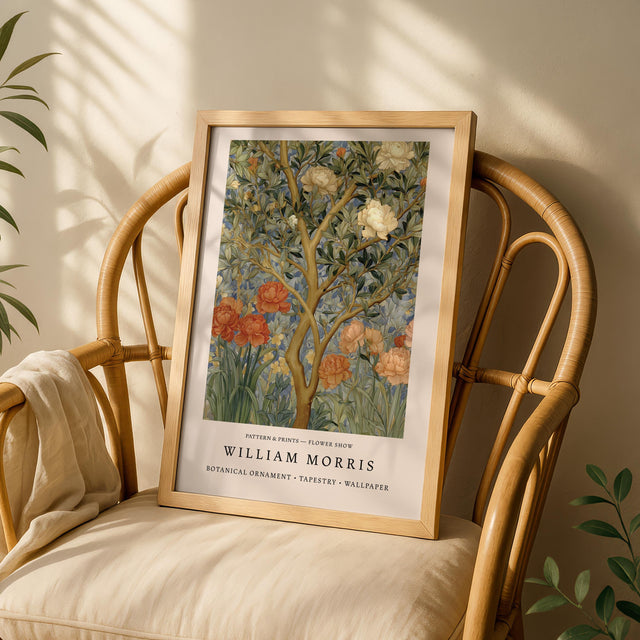
In the picture, Morris's autumn peony tree has taken the seascape's place. It works because it is warm without being loud, which is what a wall you look at every day needs. Keep the summer print flat in a drawer or behind the sofa, and swap back when the evenings get light again.
Layer a small print in front of a big one
On a sideboard or a deep shelf, lean a large print against the wall and stand a smaller one in front, overlapping its lower corner by a third or so. Nothing gets hung, and the two layers give the surface a depth one flat picture can't. We tend to keep the front print at around half the height of the back one, so both still read.

-
Autumn Mountain Path Print
Regular price From £19.00Regular price -
White Lotus Print
Regular price From £19.00Regular price

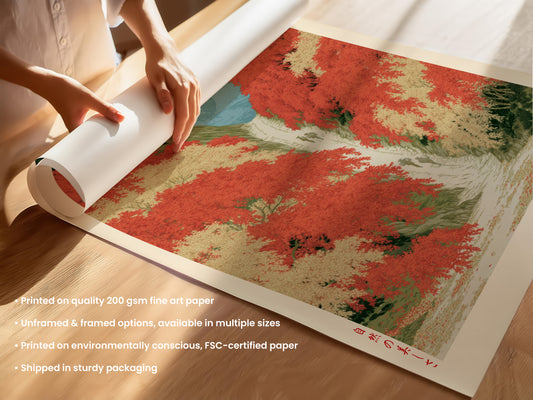

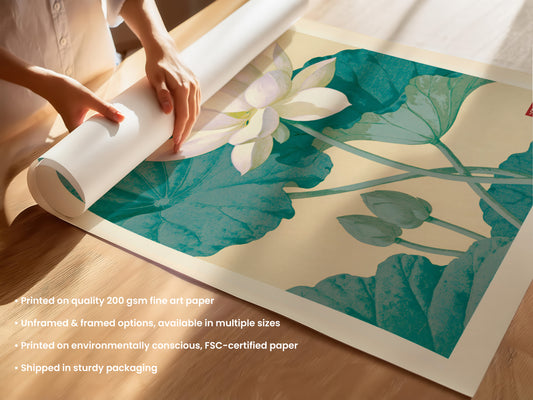
Put a warm landscape at the back and something cooler in front, like the blue-green rain print in the picture. One cool note against all that ochre keeps the pairing from going muddy. Add a lamp to one side and a small object, a pebble or a candle, to anchor the arrangement.
Lean a big print on the mantel
If you have a chimney breast, rest a large landscape print on the mantel instead of hanging it. We aim for roughly two thirds of the mantel's width, so a 120 cm mantel takes something around 80 cm across, close to a landscape A1. Push it back against the wall, centred, and let a candlestick or a small jug sit off to one side. With no hook involved, you can lift it down in spring and lean something else in its place.

-
Evening Street Print
Regular price From £19.00Regular price -
Autumn Corner Bookshop Print
Regular price From £19.00Regular price


A wide, calm landscape like the cottage scene in the picture is enough to hold a chimney breast on its own. If you lean a framed print, a shatterproof front is worth having on a ledge where things get knocked, and ours are plexiglass rather than glass.
Style a corner with branches and books
An empty corner or the end of a console table can carry a small autumn scene. Stand a tall jug of seed heads or bare twigs at the back, stack three or four books flat beside it (cloth spines look best), and lean a small print against the wall behind.

The RHS describes honesty seedpods shimmering in dried winter arrangements. It also suggests collecting teasel seed heads once they are dry in autumn and hanging them upside down, and says any left over make lovely indoor decorations. For drying flowers, the RHS advice is to bunch no more than 10 stems, hang them upside down somewhere dark at room temperature and leave them for two to three weeks. We would add papery dried allium heads if your garden has them.
-
Autumn Cottage Bookshop Print
Regular price From £19.00Regular price -
Acorn Books Print
Regular price From £19.00Regular price

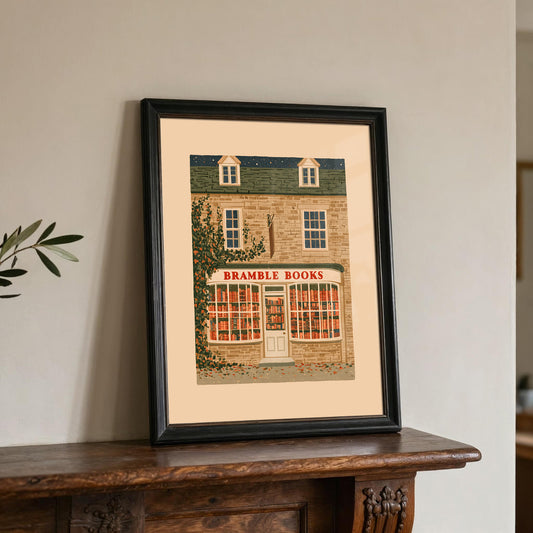


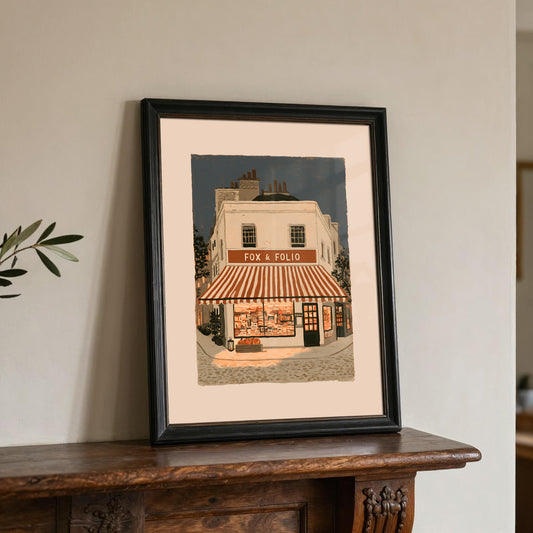
A print with lit windows, like the bookshop in the picture, belongs beside a stack of your own books. Leave a lamp on in the corner and the painted windows seem to pick up its glow.
Make one wall moodier
Choose one wall for the darkest print you own, ideally the one behind a reading chair rather than the one opposite the main window. We find a dark picture in the right spot tends to recede, so the corner feels deeper and more enclosed instead of heavier, especially with a lamp on beside it. Opposite a window, the same print is more likely to read as a dark rectangle against the glare.

-
Vampire Cat Print
Regular price From £19.00Regular price -
Crimson Window Cat Print
Regular price From £19.00Regular price

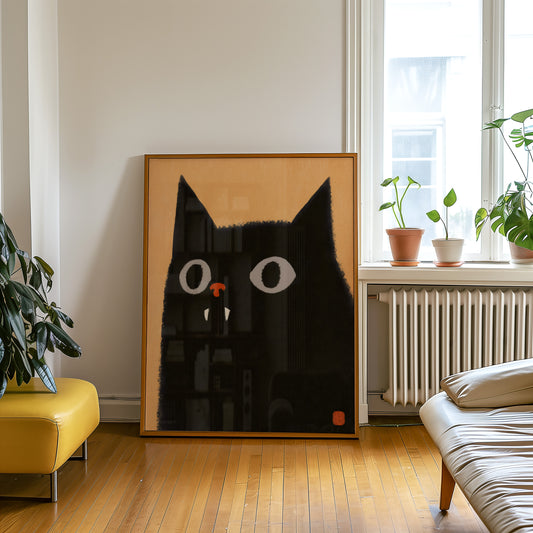


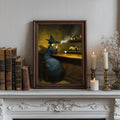
A night scene with plenty of dark in it, like the witch at the bar in the picture, does this well, and it suits most of winter as well as October. Behind a chair you can bring it a little lower than the 145 to 152 cm centre we use on an open wall, so it sits where your eye falls when you are sitting down.
Which autumn living room ideas to try first
If you only have a Saturday, this is the order we would go in.
- Turn the ceiling light off tonight and move two lamps into place.
- Swap the cushion covers and throw for the warmest ones you own.
- Measure your sofa and aim for two thirds of its width, with one print or a pair.
- Take down one cool print and put something warmer in its place.
- Collect teasel or honesty seed heads on a dry day and hang them up to dry.
How we know
The sizing and hanging numbers are the rules we work to, using our own print sizes against a standard three-seater sofa (roughly 190 to 200 cm wide). The colour and lighting points are our own view, backed by Livingetc and Ideal Home on the 60-30-10 rule and Britannica on colour temperature. The seed-head advice is the RHS's.
Sources: Livingetc: a decorator's guide to the 60-30-10 rule, Ideal Home: the 60-30-10 rule, Britannica: colour temperature, RHS: everlasting flowers to grow, RHS: self-seeding wildflowers (teasel).
Keep reading
 How to plan a gallery wallA gallery wall that looks planned was usually planned on the floor first. This is how we do it, with every measurement in centimetres and inches and five layouts to copy.
 What is Japandi? The style explainedJapandi blends Japanese minimalism with Scandinavian warmth. Where the style came from, how to recognise it, and the kind of wall art that suits it.